VOCABULARY:
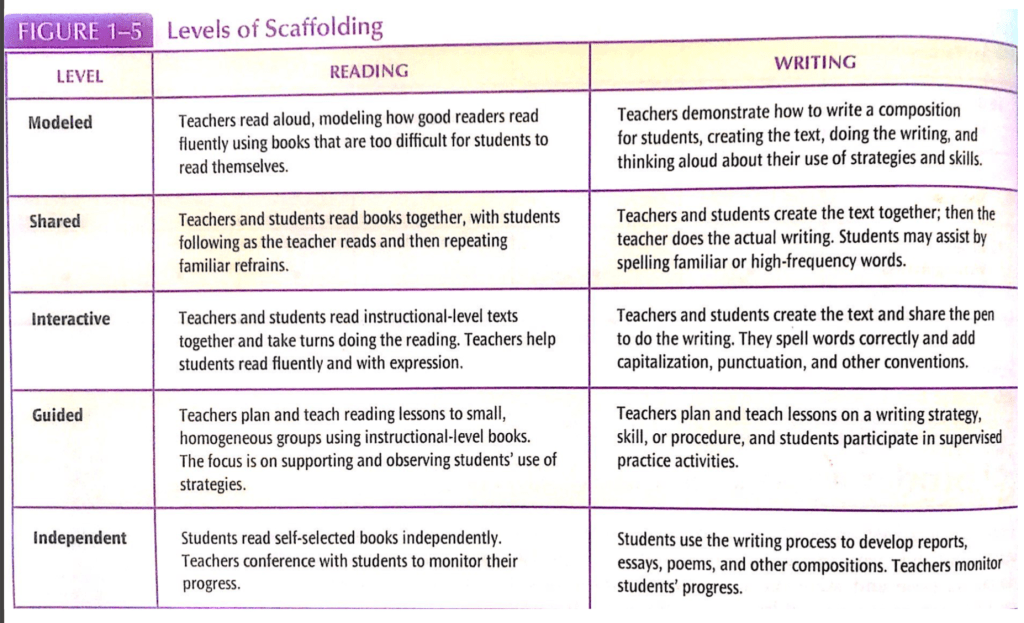
Shared reading: Used when teachers read aloud books to class that are above independent reading level but still spark interest. 5 stages of the reading process are used. After the book has been read multiple times teachers use the book to teach high frequency words and phonics.
- K-3 sit together on the carpet during their shared reading time. Drawing students’ attention should be a natural part of shared reading. Ways to keep students engaged is by asking questions, allowing comments, and prompting students to think about concepts she demonstrates such as pointing out letters, words, punctuation marks, modeling strategies, and asking questions about the concepts of print.
Interactive Writing: When teacher and students create text together. Teacher provides a guide for students to follow and the class works together to create the message. Students take turns during interactive writing. The message students work together on is on white board in front of the whole class while students are simultaneously writing the message in their notes.
- Concepts about print, letter-sound relationships and spelling patterns, handwriting, capitalization, and punctuation are learned through interactive writing.
Choral Reading: Students share the work by taking turns reading
Guided Reading: Teacher does most of the reading, but students chime in to read familiar and predictable words and phrases.
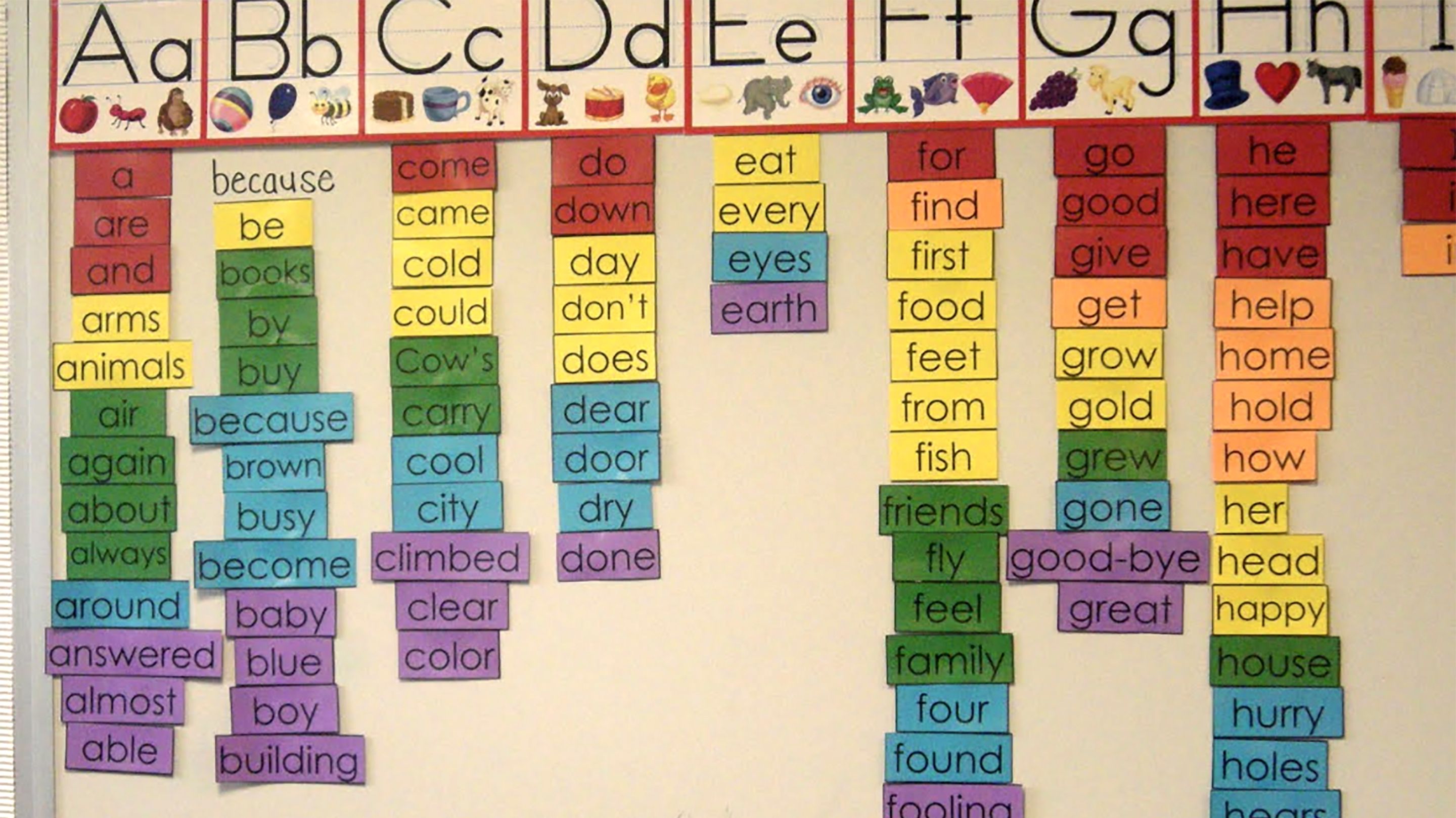
Word Wall: Filled with high frequency words
- Each letter of the alphabet has an area where words that start with that letter are.

Mini Lessons: after a lesson, students are given strategies and skills to apply what they learned. They then take part in activities that help them apply the concepts.
Interactive Read Aloud: When teacher reads aloud a book of the week, one that pertains to what students are learning, or any other book. Interactive read alouds help teach predicting, visualizing, and other reading strategies. After the read aloud is over the class and teacher have a grand conversation.
Concepts of Print: Children’s understanding that print has meaning, words have meaning, etc.
- Concepts about print can be taught by:
- Posting signs in the classroom
- Making a list of classroom rules
- Using reading and writing materials in literacy play centers
- Exchanging messages with classmates
- Reading and writing stories
- Labeling classroom items
- Drawing and writing in journals
- Writing notes to parents
- Children are also leaning directionality concepts
Concepts of Words: 4 stages of word consciousness
- Knowing no difference between words and things
- Words do stand for things
- Words carry meaning, stories are built from words
- Words have a meaning of their own and can be spoken, or written
- Children develop these skills through literacy activities (Shared Reading)
Concepts of the alphabet: Understanding that letters represent sounds (phonemes)
- Components:
- Letters name
- Knowing both uppercase and lowercase of letters
- Features of a letter distinguish it from other letters
- Direction letter is turned distinguishes it from other letters
- Use of the letter and its sound
- Sound the letter represents in isolation
- Sound letter represents in combo with others (ch, sh, th)
- Sound letter makes in context of words (cot, chair, city)

Environmental Print: Print that children recognize without even reading it. Example: store logos, brand logos, food logos, cereal boxes, restaurant logos
Assessing Concepts of Written Language: Assessment can be done through daily observations, CAP test (Concepts about Print), testing directionality, etc.
Reading and Writing Development Stages:
- Stage 1: Emergent Reading and Writing: When children start understanding that print has a communicative purpose and when they first develop an interest in reading and writing. They start to notice environmental print and start to develop concepts of print as teacher continues to read and write with them
- Children accomplish:
- Develop an interest in reading and writing
- Acquire concepts of print
- Develop book-handling skills
- Learn to identify letters of the alphabet
- Develop handwriting skills
- Learn to read and write some high frequency words
- Children are usually emergent readers during Kindergarten
- Children accomplish:
- Stage 2: Beginning Reading and Writing: child grows awareness of alphabetic principle. Children learn more about grapheme-phoneme correspondence, phonic rules, word families.
- Children Accomplish:
- Learn phonic skills
- Recognize 100 high frequency words
- Can apply reading strategies including cross-checking, predicting, and repairing
- Can write 5+ sentences, sometimes organized into paragraphs
- Spell phonetically
- Spell 50 high frequency words
- Use capital letter at beginning of sentence
- Use punctuation at end of sentence
- Reread their writing
- Children Accomplish:
- Stage 3: Fluent Reading and Writing: Students can now recognize 100’s of words automatically and can identify unfamiliar words when reading. Fluent readers and writers use the writing process to draft, revise, and publish their writing. They are familiar with many genres of writing and can use conventional spelling and other written language conventions.


Revising Groups: When students use the writing process to revise and edit their writing, they are in revising groups. They share their writing with classmates in their group seeking recommendations on how to revise and improve their writing.
Morning Message: A literacy activity done daily by some teachers. Teachers will form a message on chart paper explaining what the plan is for that day and what they can expect. Each student will have a morning message on their desk when they arrive. They read that message as a class at the beginning of the day and then count the words, letters, sentences. After that, they identify familiar words, punctuation, high frequency words, or a particular phonics pattern. Some teachers will have a fill in the blank morning message where students add the prompted word/phrase.
Predictable Books: Books that have repeated sentences, rhyme, or other patterns.
- Repetition: Author repeats sentences in a predictable pattern
- Cumulative Sequence: Sentences are repeated and expanded throughout episodes of the book
- Rhyme and Rhythm: Adds a music quality
- Sequential Patterns: Months of the year, number 1 to 10, letters, etc.
Language Experience Approach: Uses shared writing where the teacher has student talk about experience and decide what they want to “write” about. The teacher writes down exactly what the student says. Once the text is completed the student is able to read the material since it is based on their own experiences and ideas.
Interactive Writing: “sharing the pen”, teacher and students share the writing. The class all interactively takes turns writing the text in front of the class with the teachers assistance.
Manuscript Handwriting: All children enter school with different background. Some come to school not knowing how to write at all while others can write their names and a few other letters. Developing handwriting skills starts off as simple as how to hold a pencil, then learning how to write each letter with brief directions from teachers. Some teachers will sing a tune and some will model how to write letters.
Bloom’s Taxonomy Video:

CLASSROOM APPLICATION: This chapter gave so much information about how to write learning objectives and what objectives might look like. It also gave a good look at what learning the simplest things looks like through the eyes of a child. It is important for teachers to remember that each child comes to school with a different amount of experience and background knowledge on how to write, read, etc.
 Macy Bombard- ENGED Blog