Vocabulary:
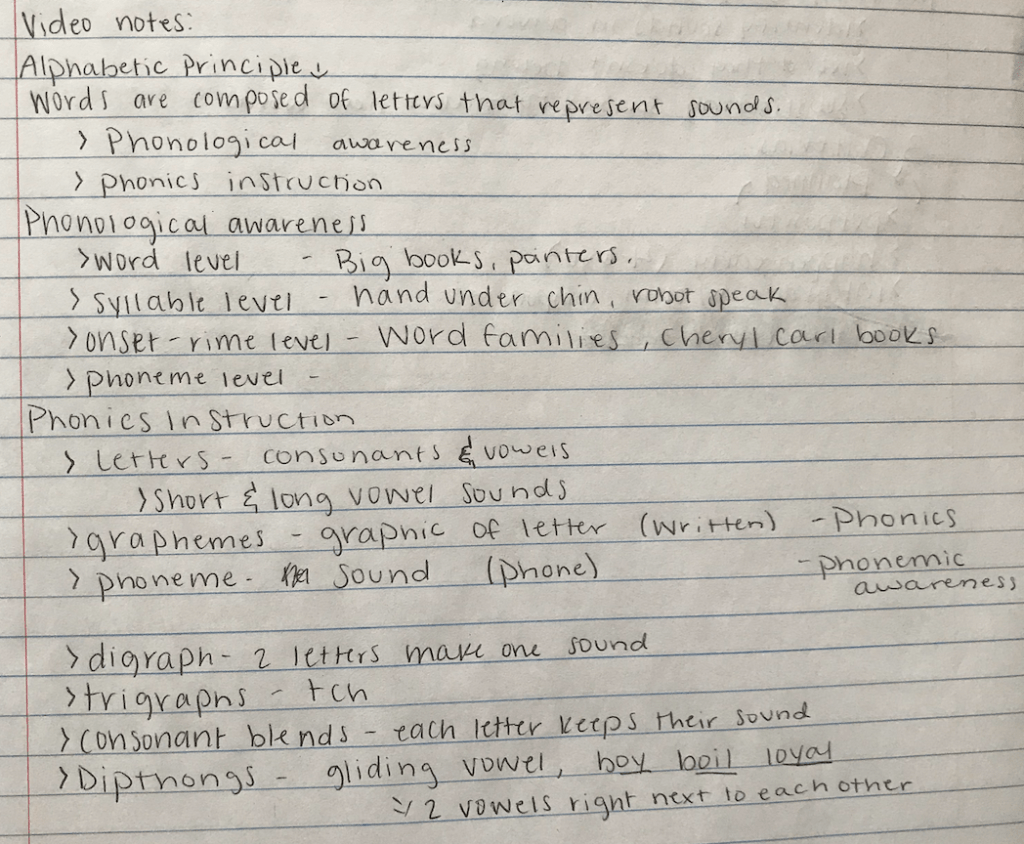
Phonemes: Smallest unit of sound
Graphemes: The letter that represents correlating sound
Graphonemic: Learned by matching letters and letter combinations to sounds, blend sounds to form different words, decode, and spell vowel patterns.
Phonemic Awareness: Basic understanding that speech is composed of individual sounds. Provides foundation for phonics and spelling.
Phonemic Awareness Strategies:
- Identifying Sounds in Words (beginning sound or ending sound)
- Categorizing Sounds in Words (Finding odd word in set of three words)
- Substituting Sounds to Make New Words (Removing one sound and adding another)
- Blending sounds to form words (Blending 2-4 sounds to make 1 word)
- Segmenting a Word Into Sounds (Finding beginning, middle, and end sound)
Teaching Phonemic Awareness: 3 Criteria
- Activities should be appropriate for 5-6 year olds; songs, rhymes, riddles, word play books
- Instruction should be planned and purposeful
- Activities should be integrated with other components of a balanced literacy program.
Elkonin Boxes: Teacher shows object or picture of an object and draws a row of boxes. One box for each phoneme in the name of the object. Child points to each box and pronounces sound, can also write letter in the box.
Phonics: Set of relationships between phonology, sounds in speech, and the spelling patterns of written language. Emphasis on spelling patterns.
Digraphs: Vowel and Consonant
- Consonant Digraph: Letter combinations that represent single sounds that aren’t represented by either letter. (ch, sh, th)
- Vowel Digraph: Two vowels represent a glide from one sounds to the next
Diphthongs: Sound produced when tongue glides from one sound to the next (2 vowels)
R-Controlled Vowels: When one or more vowels in a word are followed by an R. R influences pronunciation of vowel sound.
Onset: Part of a syllable or one-syllable word that comes before vowel.
Rime: Part of a syllable or one-syllable word that begins with the vowel.
Teaching Phonics: Best way is through combining explicit instruction and authentic application devices. Begin with consonants and then short vowels, consonant blends and digraphs and long vowels.
Stages of Spelling Development: 5 stages
- Emergent Spelling: distinction between drawing and writing, how to make letters, the direction of writing on a page, and some letter- sounds matches
- Letter Name- Alphabetic Spelling: The alphabetic principle, consonant sounds, short vowel sounds, and consonant blends and digraphs
- Within- Word Pattern Spelling: Long vowel spelling patterns, r-controlled vowels, more complex consonant patterns, diphthongs and other less common vowel patterns, and homophones
- Syllables and Affixes Spelling: Inflectional endings (-s, -es, -es, -ing), rules for adding inflectional endings, syllabication, compound words, and contractions
- Derivational Relations Spelling: Consonant alternations (soft-soften, magic-magician), vowel alternations (please-pleasant, define-definition, explain-explanation), greek and latin affixes and root words, and etymologies
Teaching Spelling: Weekly spelling tests. BUT, tests should never be considered a complete spelling program. Provide daily reading writing opportunities, teaching spelling of high- frequency words, segmenting words
Classroom Application: This chapter provided great information on how to teach certain aspects of literacy such as spellings, phonemic awareness, and phonics. The notes I took will be helpful to peek back at when I need to in the future, and will also be helpful when studying for the FORT.
 Macy Bombard- ENGED Blog
Great job covering the required content for the blog post.
LikeLike