VOCAB:
Running Record: Monitoring students ability to recognize high frequency words, decode unfamiliar words, and use reading strategies.
- This could be done while students are reading familiar books
- Running records can be used to determine reading level
Minilessons: Bringing attention and awareness to high frequency words, phonetic features of words, & capitalization/punctuation based on sentences of the week.
Book Talk: Teasers teachers use to introduce certain books to students to hook their interest.
-1st the teacher shows the book
-2nd teacher summarizes the story without giving away the ending
-3rd teacher passes the book off to a student who is interested or puts it in the classroom library
4 steps of assessment:
–Step 1: Planning for assessment
-planning for assessment happens at the same time as instruction planning
-Questions to consider:
-Do students have adequate background knowledge and vocab about topic to be taught?
-Are any students struggling?
-Are students completing assignments?
-Are students showing good work habits?
-Do students work responsibly together?
-Have students learned concepts?
-Can students apply what they’ve learned in authentic literacy projects?
–Step 2: Monitoring Students’ Progress:
-This step is VITAL
-This is when teachers monitor their students learning on a day to day basis and use results to make instructional decisions.
–Observations: “kid watcher”, focusing on what students are doing as they read or write. Focus is on literacy, not behavior
–Anecdotal Notes: When teachers write brief notes as they observe students. This can be done with stick notes and a notebook. Assigning each student a page in the notebook and putting the stick notes about them on their page. Notes should describe specific events. These notes monitor and document student’s growth.
–Conferences: When teacher meets with student
-On the spot: Teacher visits each students desk, brief
-Planned: Happens before reading or writing
-Revising: Small group of students meet with teacher
-Book discussion
-Editing: Teacher reviews students composition and makes suggestions
-Evaluation: Teacher meets with student after assignment
–Checklists: Lays out what is expected of the student.
-Book Talks
–Step 3: Evaluating students’ learning:
-Assessment is summative
-Tests or evaluations are on students’ actual reading or writing
-Students work sample
–rubrics: Scoring guides to evaluate students performance according to specific criteria & levels of achievement
-Websites:
-Rubrics 4 teachers
-Rubistar
-Teach-nology
-6 + 1 traits
–Multimodal Assessments: More Broad way to asses reading and writing. Teachers should consider, (a)The literacy strategies that students employ, (b) The variety of print and digital texts students read, (c) The digital resources students use, (d) Students ability to collaborate with classmates, (e)The multiple ways students demonstrate learning (oral, written, visual)
–Step 4: Reflecting on Students’ Learning
-Reflection on instruction and how future instruction can be changed
-Analyzation of student achievement
-Students also reflect upon their experience
(Portfolio) Assessment: A collection of students’ work to help them evaluate their progress and show off their best work.
-portfolios help both teacher and student to see patterns of growth
-help students to feel ownership of their work
-Students feel more responsible for their work
-Students can set goals and feel motivated to work toward them
-Students make connection between learning and assessing
-Teachers use portfolios during parent conferences
Independent Reading Level: Level where student can recognize almost all words, their reading is fluent, and they are able to comprehend what they are reading.
-Slightly easier than instructional reading level
Instructional Reading Level: Student can read with support, not on their own. Can recognize most words, some fluent reading some not. Student can comprehend what they are reading with support from teacher and peers. When reading independently, comprehension is limited.
Frustration Reading Level: Books that student cannot read successfully or with assistance. Minimum word recognition, reading is choppy and wordy by word. Student shows very little understanding about what they are reading.
Leveled Books: Books are arranged from easiest to hardest, by a 26-level continuum.
-Variables considered:
-Genre and format
-Organization and use of text structures
-Familiarity and interest level of context
-Complexity of ideas
-Language and literacy features
-Sentence length and complexity
-Sophistication of vocab
-Word length and ease of decoding
-Relationship of illustrations to the text
-Length of book
Lexile Framework: Another way to match books to readers. Two factors: Word familiarity and sentence complexity. Scores range from 100 to 1300.
-Wide range of levels makes matching reader and book together more specific.
Informal Reading Inventories: Used to evaluate students’ reading performance. Used for 1st -8th grade. Also used to determine whether students are reading at grade level, identify student’s struggles.
-Two parts:
-Graded word lists: 10-20 words from easiest to hardest. Student reads until words become too difficult
-passages: Student reads passage and answers 3 comprehension questions. Teachers have chance to examine comprehension, fluency, vocab knowledge
Miscue Analysis: Noting words that student is having a hard time reading. When student mispronounces words, it is noted as what the word is and what the student says.
SOLOM: An authentic tool for assessment, Student Oral Language Observation Matrix, not a test but a rating scale. Teachers use this while EL’s are speaking and listening to track how well they are grasping the English language.
–Five components of Oral Language:
-Listening: score from continuum rating from not able to comprehend simple statements to being able to understand everyday conversations.
-Fluency: scored on continuum from halting, fragmentary speech to fluent.
-Vocabulary :Scored on continuum from extremely limited word knowledge to using words and idioms skillfully.
-Pronunciation: Scored on continuum from unintelligible speech to using pronunciation and intonation proficiently.
-Grammar: Scored on continuum from excessive errors to being able to apply word order, grammar, and usage rules effectively.
-Each component has 5-point range making maximum score 25. A score 20 or higher signifies that the student is fluent
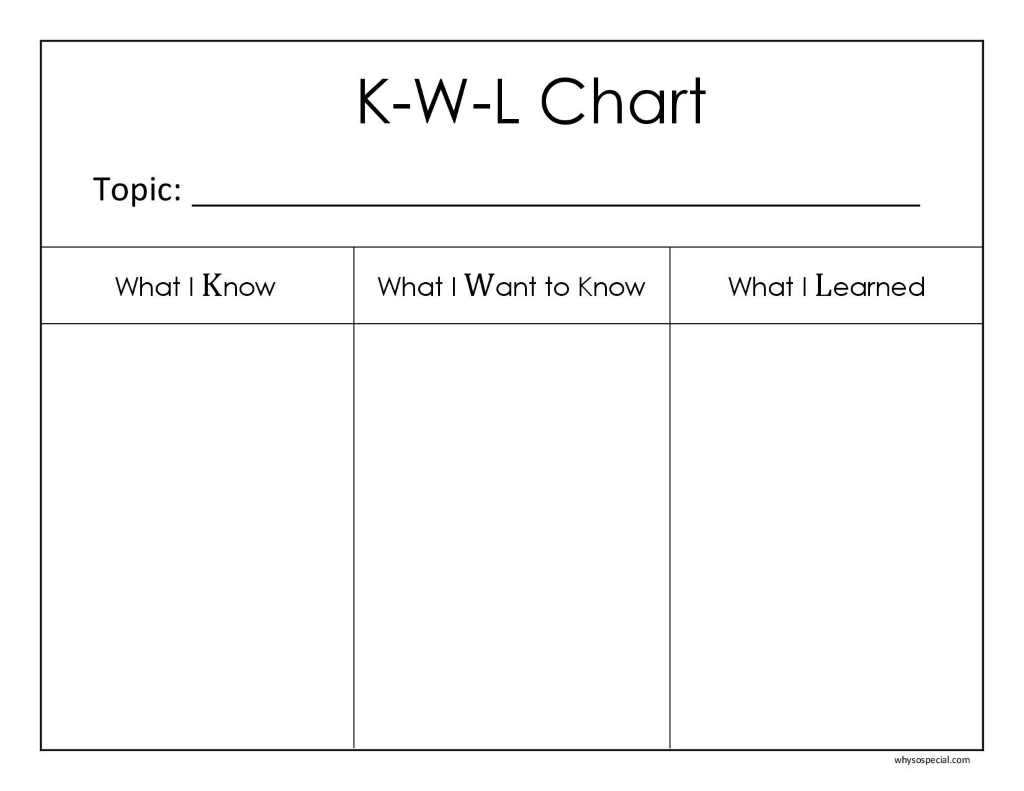
KWL Charts: A way for teachers to identify what ELL’s know (their background knowledge) before teaching. Before instruction the first two sections are filled out. After the lesson, once new vocab/concepts are introduced, the third section is completed.
Test Taking Strategies: Students learn these strategies and are able to choose which ones best apply to each test they take. Most standardized tests are multiple choice.
-Read Entire Question First: This is so students fully understand what is being asked. With reading passages, questions should still be answered first so that students know what to look for when they are reading.
-Look For Key Words in The Question: Key words such as compare, except, and authors intent are a good guide as to what to pay attention to.
-Read all Answer Choices Before Choosing the Correct Answer: After reading the question, students should think of the answer first, then read the choices. They can then eliminate answers they know are not correct.
-Answer Easier Questions First: Skip the difficult ones and come back to them after the tough ones.
-Make Smart Guesses: This is done by eliminating unlikely answers and using process of elimination keeping in mind what the question is asking and what they have learned about that topic.
-Stick With Your First Answer: Students should never second guess themselves.
-Pace Yourself: Students should budget their time so that they do not spend too long on a question and run out of time.
-Check Your Work Carefully: Make sure all questions are answered.
High Stakes Testing: Designed to measure students’ knowledge according to grade level standards.
-Problems with high stake testing:
-Students feel the added pressure
-Struggling students tend to get overwhelmed and discouraged. Over time student’s motivation will be destroyed.
-Student drop out dates are rising
-Teachers feel that they are losing time with of balanced approach instruction because they are too busy preparing for the test.
Classroom Connection:
This chapter provided a lot of good information on how to assess student’s reading levels. I particularly took a liking to the running record. I remember when I was young, my teachers would do something like that, and I always wondered what they were marking down, but now I know. I also liked the idea of each student having a page in a notebook for sticky notes regarding what is observed about them.
 Macy Bombard- ENGED Blog
Excellent job on your blog post!
LikeLike